

Data centres reject heat all year, but district heating needs it in winter. The Thunder project bridges that seasonal gap with thermochemical storage.
Europe’s data centres are often seen as an energy challenge. For district heating operators, however, they represent a valuable heat source. Data centres convert almost all the electricity they consume into low grade heat, typically 25-35°C with conventional cooling and higher with liquid cooling, continuously throughout the year.
Globally, they consumed an estimated 415TWh of electricity in 2024, around 1.5% of global electricity demand. Although most of this heat is still released into the atmosphere, heat recovery is becoming more common.
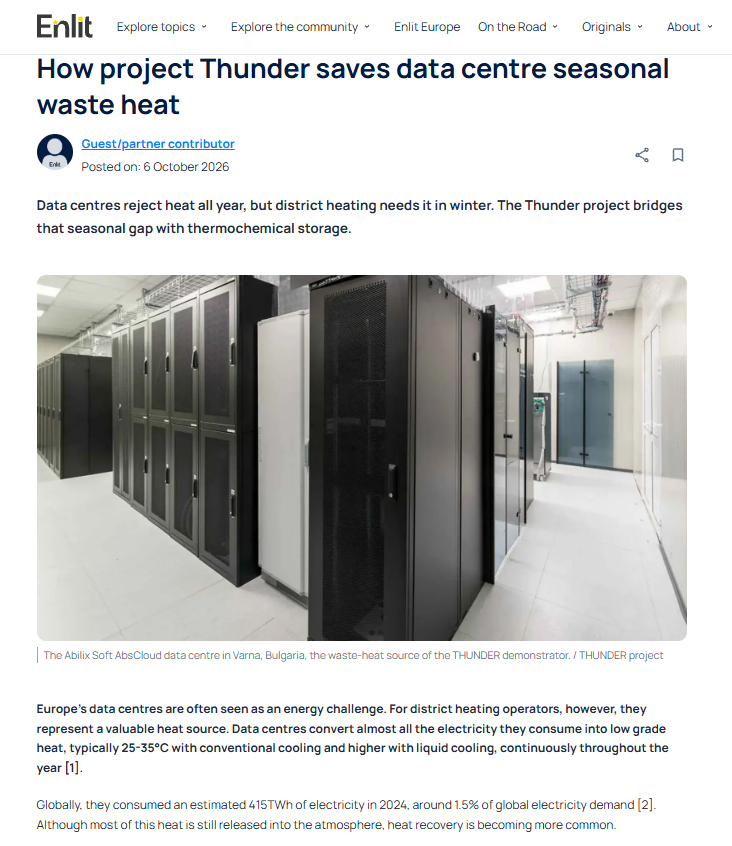
THermochemical storage Utilization eNabling Data centre seasonal Energy Recovery (Thunder) is a Horizon Europe project running from 2024 to 2028. Its demonstration site is in Varna, Bulgaria, where Veolia Energy Varna operates a district heating network serving more than 15,000 customers, while Abilix Soft Ltd operates the AbsCloud data centre supplying the waste heat.
The main challenge is seasonal mismatch: data centres generate heat all year, but district heating demand is highest in winter. Recovering heat directly into the network captures only the amount needed at that moment.
Thunder addresses this by storing surplus summer heat for winter use. Waste heat is upgraded by a high-temperature heat pump and stored in thermochemical materials (TCM), which can retain energy for up to six months with minimal losses.
Authors: Burcu Unluturk and Nora Fischer, project managers at IVL Swedish Environmental Research Institute.
The full article can be found at ENLIT 2026 website: https://www.enlit.world/library/how-project-thunder-saves-data-centre-seasonal-waste-heat?utm_campaign=topic_hub_projects_email_9_oct&utm_medium=email&_hsenc=p2ANqtz–mNcqGBiHnmkcpt7ZDiIvdRbibB8DKV8wHmcyzkhNqLxJOwvhWdrMjoAmR-55i7PlNTo0-DnrgYQ_NaeePxzfvpc5w1Q&_hsmi=147725790&utm_source=enlit_world